2.5. Bio-decontamination of surfaces
Biological decontamination of thermo-sensitive plastic materials used in medicine or in food packaging, from bacterial spores, biofilms, and other resistant microbial pathogens represents a technological challenge. Direct decontamination of oral biofilms grown on human teeth is as a potential future application of cold plasma in dentistry.
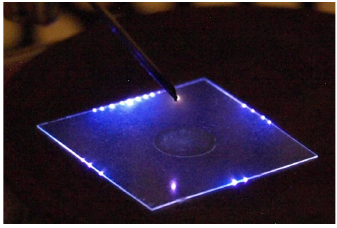
Cold air plasmas generated by DC and pulsed corona discharges - positive streamers and negative Trichel pulses were tested for eradication of Bacillus cereus spores and Streptococci biofilm on polypropylene plastic surfaces and extracted human teeth. Both polarities of DC and pulsed coronas can reduce the spore or bacterial population in the biofilm up to 2-3 logs in 10 min exposure time. No significant polarity effect was found with DC corona. Pulsed corona was demonstrated slightly more bactericidal for spores, especially in the negative polarity
(Kovalova Z. et al., 2013).
The 3-log bactericidal effect can be reached faster (within 2 min) when applying
electrostatic spraying
of water through the discharge onto the treated spore/biofilm contaminated surfaces. We attribute this significant enhancement of plasma combined with electrospraying of water to the enhancement of the mass transfer of the air plasma generated reactive oxygen and nitrogen species (OH•, H2O2, O2-•, O3, NOx) into water inducing chemical changes in water related to strong biocidal effects
(Machala Z. et al., 2013).
The same air plasma discharges were demonstrated to efficiently inactivate oral biofilms grown on teeth without any damaging effect of tooth surface composition and structure
(Kovalova Z. et al., 2014).
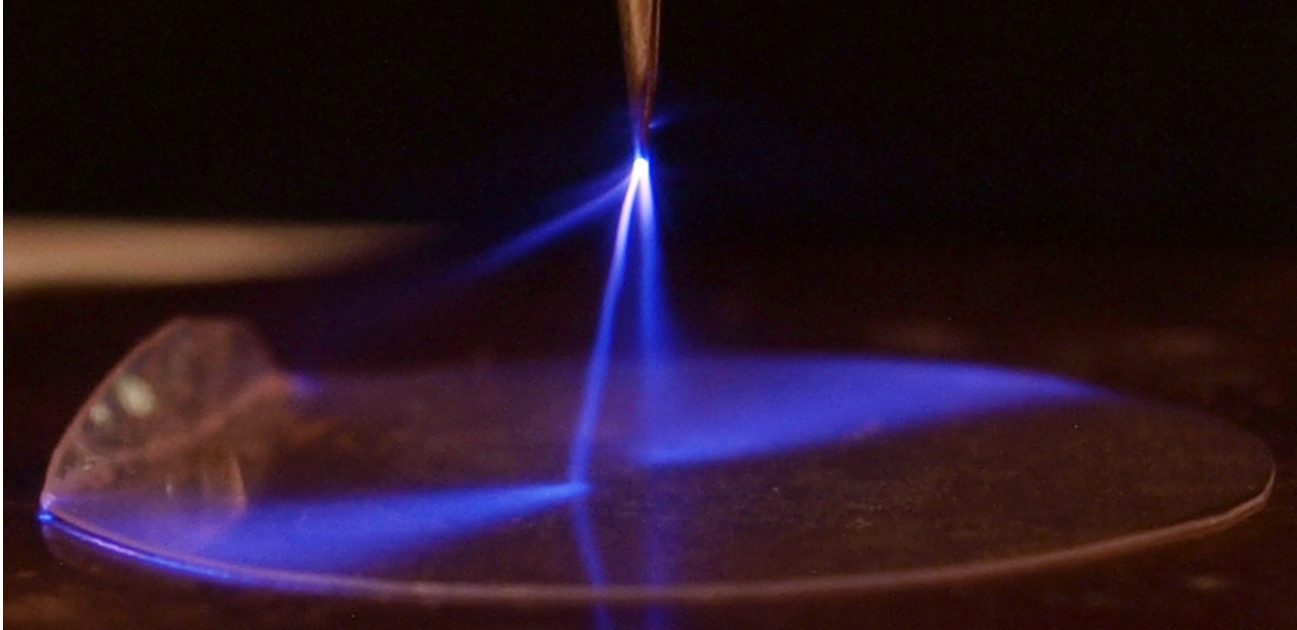 |
Fig. 1. The positive streamer corona discharge over a polypropylene surface contaminated by Bacillus cereus spores. U = 6 kV, f = 15 kHz, Imax = 100 mA. |
back to top |
previous |
next
|
|